Author Lorelei Bell, welcomes you! Vampires are my addiction, I assume they are yours as well. Come and journey with me to the darker shadows, where the vampires lurk, watching us, waiting for us weak humans...

The journey awaits, come!

Wednesday, February 9, 2011

Demon Eco Says God Created Angels For A Reason!


Now, you have to remember who Eco is!
For those of you who did not read The House on Blackstone Moor, Eco is demon spawn and thoroughly evil.

He is also, as my most recent reviewer wrote, 'I like Eco, he is demented and brilliantly so.' 
I have to say I like him too and frankly, the sequel, Unholy Testament, features him.

Now, since he has all the time in the world, he has experienced so much. There will be all sorts of little 'Eco gems' that he will come out with. For instance, he will tell the reader his reasoning as to why God created angels.

It was he believes, to have witnesses to creation. As he says: "I can understand him wanting an audience, truly I can. As for myself, I'd have been bored to tears, it was after all only a light show, stunning though it may have been!"

Yes easily bored is Eco. However there is that which does excite him.

Eco again: "What delighted and inspired me was my discovery of conjuring!"

We do already know about his conjuring. Remember his 'children?' Those horrific creatures he created that he considers his own flesh and blood: those vile, demonic, flesh-eating monsters he had attack people?!

In Unholy Testament we will discover how he learned to conjur them, what the circumstances were and so forth.

Apparently, from what I can tell, he learned this craft in ancient Egypt, despite the fact that the magic practiced by Priests there was not evil. Leave it to Eco to find the right Priest, a priest to teach him all about the ways of dark conjuring!

Of course as time went on and Eco continued to exist there were other eras. Each with its own wizards and magicians and Eco there to take it all in!

It was the conjuring of his 'children' that most people find so fascinating.
Yes, it's going to be quite a journey, stay tuned!

Thursday, February 3, 2011

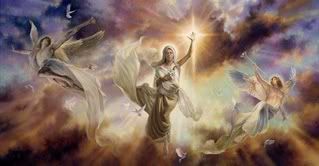
What Is It About Angels and Devils?

We're fascinated by them.  Right now I'm reading Anne Rice's Memnoch the Devil and I find it profound and brilliant. It is one of the most unforgettable books I have ever read.

I won't review it here now, I'll be doing that on Goodreads shortly. What I do want to discuss is the subject matter.

What intelligent person doesn't have questions about God, creation and Heaven and Hell? We want to know. We can believe, that is the miracle of faith but I think we also want very much to know, to have all the answers to all the many questions we have. Perhaps it for this reason alone these kinds of books are as popular as they are.

That aside, I am fascinated by good and evil and the constant battle between the two. Angels might be God's foot soldiers, His helpmates. They know what He wants to do and they will do it without Him even asking. And He's pleased with his children of light.

They either exist or they don't. We can believe or not. What I am delighted about is they have become popular subject matter for fiction along with their evil counterpart.

Having them interact with characters we create is terrific. Having them then spar with one another good against bad is mind blowing.

As this is going on, in its very depiction, we are challenged as to what we believe.

If there be monsters then there also be angels to save us. If one thing comes from hell the other surely comes from Heaven.

Mightn't Heaven realistically or symbollically be there with the promise of salvation? And if it is, surely the characters we create fight the most important battles we can possibly imagine, conflicts that really mean something!

Wednesday, February 2, 2011

A Review From A Convert! Well, Decide For Yourself!


"Gothic horror. Not really my cup of tea, but Carole Gill's novel is a smooth read from page one and onwards..."

Lee Pletzers, publisher of Triskaideka Books has given me a great review. It's on Lee's own book review site, The Lonely Reviewer:

http://reviewer-sffh.blogspot.com/

The review is also on Smashwords:

http://www.smashwords.com/books/view/33847

He doesn't even like gothic horror, but he liked my book! I can't tell you (but I'll try hardest) how much that means to me!

You see, I want to bring new readers into reading gothic genre books. That is my aim and I feel this is a first step.

I feel the gothic narrative is a great one and deserves to be given new life and energy. It must, I feel, be imbued with far darker themes and bolder storylines. I don't say, 'gothic romance was never like this,' for nothing. It has to change and I want to help to change it.

Here's the rest of his review:

"...Chapter one is interesting and thrusts the reader straight into the world of Rose Baines with a nice tag at the end that forces a page turn.


Coming home to see her family slaughtered by her father, see is struck weak and taken to an insane asylum to recover, where on her first night in a solo room she is abused. This is just the start of the horrors she will soon be faced with. There are sex rituals, sacrifice, vampires, demons (I like Eco, he is demented and brilliantly so), children vamps, and the leader, Louis Dartion, oh and gypsies.

All Gothic fans will love this book and Carole has created characters we can all identify with. Rose is a shy and uncomfortable around strangers and has a tendency to faint. Louis Dartion is the opposite but he too has a soft side. Some of the characters are in the story to move the plot along but most are interesting characters, like Dartion's wife, Marta and Reverend Hobbs.

Secrets will be exposed that will rock Rose's world and throw her life in turmoil. The amount of twists and turns this book takes will leave your head spinning and guessing until the end. And the journey Rose takes in this book is truly epic and you'll enjoy reading her exploits and adventure late into the night."

Thank you, Lee!
And remember everyone! The sequel, Unholy Testament is coming!
 

Saturday, January 29, 2011

Can We Pity The Damned?

Just going to make the focus of this question general. It refers to both The House on Blackstone Moor as well as the sequel, Unholy Testament.

A lot of dark things come out of the first book. Human beings and demons alike are shown to be capable of great evil, of horrific violence and the worst sins imaginable.

Louis was referred to by one of the books' reviewers as a Byronic hero. Perhaps he is. After all, he's  damned through no fault of his own yet he has a moral code he exists by, despite the fact that it ensures absolutely nothing will come of it. Louis Darton because of his father's support of Lucifer knows what his destiny is. As he says:

I am what I am... no promise of heaven awaits me. I have too much  freedom and no restraint…”

Think about it! How would we behave if there was no reason to live a decent and honorable life? Would we live principled lives if nothing we did counted, if there was no punishment ever?

Can those creatures (whatever they are) vampires, fallen angels, demon spawn, be the object of our pity ever? Should we try to see how it all began for them? Why it was and how they came to be what they are?

I probe these questions in the first book as well as the second. And this probing and pondering has led me to some very surprising conclusions--or questions. And let me say, I don't always know the answer!
But I do know something. I think  this debate all hinges on one word: 'pity.'

And that leads me to one surprising conclusion: which is, I think, I can have more pity in my heart for a vampire or a marauding werewolf on the loose than I can for an unrepentent entirely human serial killer.

What about you? What do you think?

Sunday, October 3, 2010

Murder and Madness: Porphyria's Lover by Robert Browning!

A tale of madness and murder! A tale with so many possiblities as to interpretation, it will obsess you!

Yes!  Another blog post inspired by two people: Poet Robert Browning who is dead many years and Margarita Georgieva who is very much alive!
Therefore I will be grateful to Mr. Browning and enthusiastically thank Margarita once again!

One important note: porphyria is a disease but it was not identified as such when the poem was written.

My rant:
Robert Browning wrote one particular poem that I find haunting! It is not only a work of dark beauty, it is also a puzzlement, you turn it one way in your search to unlock its awful secrets and just when you think you’ve solved it, you discover another explanation for its meaning, all of them valid.

Some background:
Porphyria’s Lover is a poem that was first published as "Porphyria" in the January 1836 issue of Monthly Repository.

A possible inspiration for the poem is John Wilson's "Extracts from Gosschen's Diary", which is based on a lurid account of a murder published in Blackwood's Magazine in 1818. Browning's friend and fellow poet Bryan Procter acknowledged basing his 1820 "Marcian Colonna" on it, but added a new detail; after the murder, the killer sits up all night with his victim.

You will see that in this poem as well!
Excited? Well, here we go:

Porphyria’s Lover by Robert Browning:

The rain set early in tonight,

The sullen wind was soon awake,

It tore the elm-tops down for spite,

And did its worst to vex the lake:

I listened with heart fit to break.

When glided in Porphyria; straight

She shut the cold out and the storm,

And kneeled and made the cheerless grate

Blaze up, and all the cottage warm;

Which done, she rose, and from her form

Withdrew the dripping cloak and shawl,

And laid her soiled gloves by, untied

Her hat and let the damp hair fall,

And, last, she sat down by my side

And called me. When no voice replied,

She put my arm about her waist,

And made her smooth white shoulder bare,

And all her yellow hair displaced,

And, stooping, made my cheek lie there,

And spread, o'er all, her yellow hair,

Murmuring how she loved me — she

Too weak, for all her heart's endeavor,

To set its struggling passion free

From pride, and vainer ties dissever,

And give herself to me forever.

But passion sometimes would prevail,

Nor could tonight's gay feast restrain

A sudden thought of one so pale

For love of her, and all in vain:

So, she was come through wind and rain.

Be sure I looked up at her eyes

Happy and proud; at last I knew

Porphyria worshiped me: surprise

Made my heart swell, and still it grew

While I debated what to do.

That moment she was mine, mine, fair,

Perfectly pure and good: I found

A thing to do, and all her hair

In one long yellow string I wound

Three times her little throat around,

And strangled her. No pain felt she;

I am quite sure she felt no pain.

As a shut bud that holds a bee,

I warily oped her lids: again

Laughed the blue eyes without a stain.

And I untightened next the tress

About her neck; her cheek once more

Blushed bright beneath my burning kiss:

I propped her head up as before,

Only, this time my shoulder bore

Her head, which droops upon it still:

The smiling rosy little head,

So glad it has its utmost will,

That all it scorned at once is fled,

And I, its love, am gained instead!

Porphyra’s love: she guessed not how

Her darling one wish would be heard.

And thus we sit together now,

And all night long we have not stirred,

And yet God has not said a word!

I don’t know about you but I find the poem dark and deeply disturbing.

The themes I see are madness and murder, the death by strangulation of a beautiful young girl by her deranged lover.

The gist:
There is a storm raging and Porphyria comes into the room where there isn’t even a fire.
Her lover has been sitting there, what in the cold? And if so why?
She sits down next to him and speaks to him although he doesn’t answer her, I see her as then trying to play up to him a bit by putting his arm about her waist.
She bares her shoulder; she then snuggles up to him so that his cheek is on her hair.
He knows she is his and just at that moment he strangles her, carefully assuring the reader that she felt no pain and that she smiled.

R for rationalization, I say!

He goes on to tell us she never cried out! Hard to I think when one is being strangled.
He further tells us she felt no pain but then qualifies it. "I am quite sure she felt no pain."
I imagine him possibly also thinking: “At least I hope she had no pain...”
He’s killed her, she’s dead so what does he do?
He opens her blue eyes and is pleased ‘they don’t look ‘strained.’ He then spreads her hair about her neck and gives her a ‘burning kiss’ (?!)

Charming!

He then goes on to tell us he props her head up and lets it rest on his shoulder.
And if this isn’t weird enough he lets us know that he sits with her corpse.
But it’s all okay apparently because ‘...God has not said a word!’

Please read:

I warily oped her lids: again
Laughed the blue eyes without a stain.
And I untightened next the tress
About her neck; her cheek once more
Blushed bright beneath my burning kiss:
I propped her head up as before,
Only, this time my shoulder bore
Her head, which droops upon it still:
The smiling rosy little head,
So glad it has its utmost will,
That all it scorned at once is fled,
And I, its love, am gained instead!
Porphyria's love: she guessed not how
Her darling one wish would be heard.
And thus we sit together now,
And all night long we have not stirred,
And yet God has not said a word!

I mean I like to think of myself being as religious as the next person but what does Porphyria’s lover think, does he really believe God would have made his displeasure known by telling him?

It may be of some interest to know that in Browning’s My Last Duchess a woman is also killed by the man who loves her.

Pardon my glibness but I wonder what Elizabeth Barrett Browning thought of these works.

I do agree that there are many valid interpretations; I however feel that Browning was writing about a madman who rationalized the murder of his lover.

He does this powerfully having us witness all of it through the murderer’s eyes. I find that very moving indeed to see what Porphyria’s lover saw, from his own point of view.

I also then see a deliberate choice by Browning to call the poem, Porhyria's LOVER as it is her lover who extinguished her life, motivated by his own mad reasoning.

So in essence, Bronwning, I think, has us witness the murder of a beautiful young girl who might have only chosen to love the wrong man. A man who after killing her is still so drawn to her, so obsessed by her that he sits with her corpse by his side, unable or unwilling to let her go!
One wonders just when he does let her go.

I do not see an end to this poem either, but a terrible continuation because somehow in my writer’s imagination I see him sitting there still, in a cold, darkened room for there is no longer a fire—chilled but happy to be near his long-dead Porphyria.

But along with this I hear the sound of a battering ram. I hear too the wood splitting apart as the door is being broken down and the terrible secret of Porphyria’s Lover is about to be revealed!

(the end)!